
Space Oddity
Do Panic!

The final frontier?
We are all in the gutter, but some of us are looking at the stars.— Oscar Wilde

“I’ve come to believe it’s not so much what you believe... it’s how hard you believe it.” – Indiana Jones (Dial of Destiny)
HEADING SOUTH
The South Sea Company was a British joint-stock enterprise founded in 1711 to resolve the problem of the spiralling debt burden of the newly formed Kingdom of Great Britain (England and Scotland had been joined in 1707 by the Act of Union – a shotgun wedding in which around one million reluctant Scots were forced to the sovereign altar).
It is best known today for triggering one of the most devastating financial crashes in human history—the South Sea Bubble of 1720.
1. An ambitious plan….
The company was devised by Tory Lord Treasurer Robert Harley as a public-private financial mechanism to alleviate Britain’s national debt crisis. (it’s worth remembering this when you hear the likes of Kemi Badenoch talking of Tory financial rectitude or when public-private partnerships are proposed as the solutions to financial problems.
Britain’s involvement in the actual first world war (The Thirty Years War) had left a legacy of debt that became increasingly problematic during Britain’s expensive involvement in The War of the Spanish Succession. The British government owed over £9 million to various army, navy, and civilian creditors and in the pre-FIAT days, this was a debt that had to be backed by bullion. In fact each unit of the British currency was originally backed by one pound of Sterling Silver – hence the derivation of the term ‘Pound Sterling’.
The Swap
The government allowed creditors to exchange (swap) their unsecured state debt for shares of the newly formed South Sea Company.
The Incentive
The government guaranteed the company a permanent 6% interest payment on the total debt absorbed. More enticingly, Parliament granted the company a total monopoly on British trade with South America and the surrounding “South Seas”.
2. The Problem
Unfortunately, the newly formed Kingdom of Great Britain was not a major power in South America, where Spain dominated in the most part and Portugal had laid claim to Brazil for over two centuries.
3. Asiento: The Slavery Contract
The South Sea Company did have trading rights with the mainly Spanish colonies, however. The War of the Spanish Succession concluded with The Treaty of Utrecht, in which Spain stripped Britain’s competitors of the Asiento de Negros (the Negroes’ Contract) and awarded it exclusively to Britain, mandating the South Sea Company to supply 4,800 enslaved Africans per year to Spanish-held American plantations for a span of 30 years along with one general trading ship per year to its ports.
4. The Illusion:
Even though actual slave-trading revenues were minimal and plagued by high operating costs, the company’s directors heavily exaggerated the market potential to artificially pump-up stock prices.
5. The Bubble
By 1720, the company pivoted from simple trade to a massive scheme to assume the entirety of Britain’s remaining national debt (£31.5 million). Directors bribed politicians, handed out stock options to royalty, and offered loose credit terms to buyers. This fuelled a frenzy, in which the stock price skyrocketed in mere months. Sensing the opportunity, a myriad of other joint stock companies were launched. Exchange Alley in the City of London was the physical centre where Stock-jobbers, brokers, and eager investors crowded into the alley’s coffee-houses (primarily Jonathan’s and Garraway’s) to speculate on the wildly surging shares of the South Sea Company and hundreds of other fraudulent “bubble” companies.
6. Exchange Alley
Exchange Alley was, and still is, a narrow-cobbled passage opposite the Royal Exchange on Cornhill, linking Cornhill with Lombard Street. At the height of the bubble it was jammed with speculators, brokers and carriages. Barred from the Royal Exchange for their ‘rowdiness and poor manners’, stockbrokers made the alley their domain. Much like the open-outcry pits of the twentieth century, it was a testosterone-fuelled theatre of aggression, shouting and fast talk. With no official stock exchange building, trading took place in or on the doorsteps of local coffee houses.
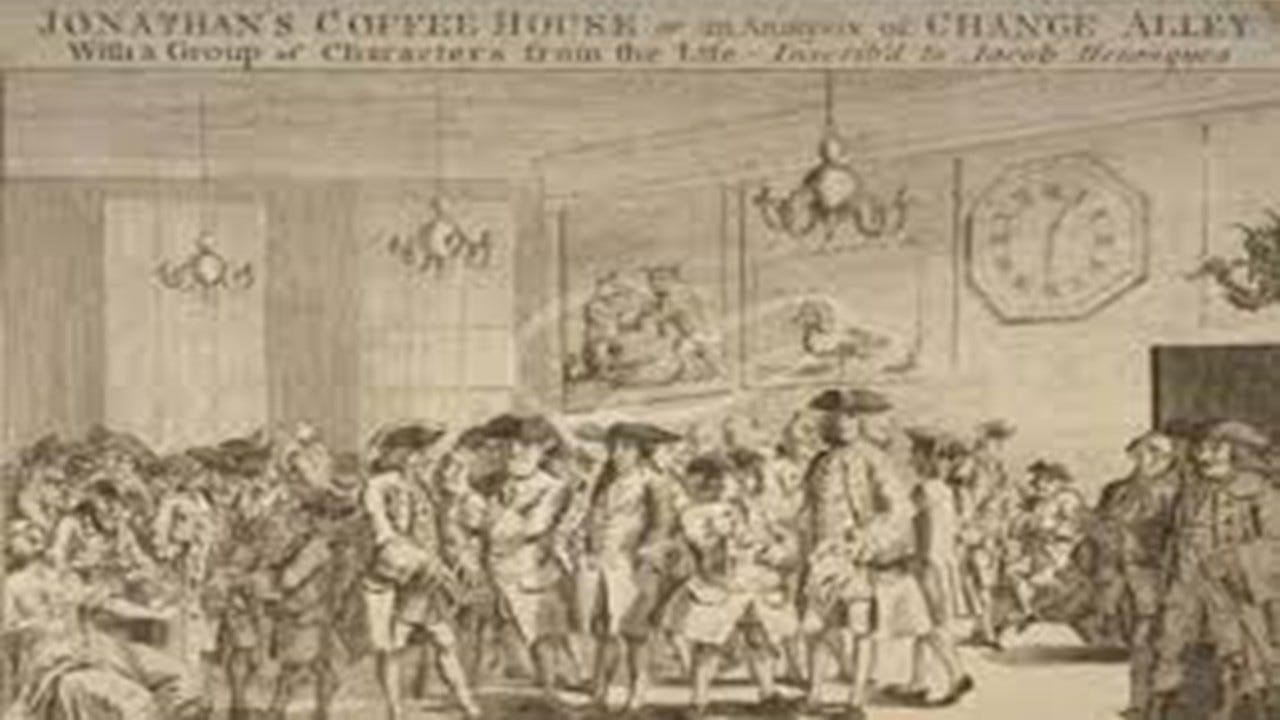
At Jonathan’s, jobbers posted daily stock prices on chalkboards for investors fortified by coffee, tea and meat pies. Garraway’s specialised in stock auctions and commodities. The alley’s proximity to the General Post Office also appeared to confer an information advantage in the days of physical mail, which in turn encouraged manipulation as jobbers exploited rapid price swings and spread false rumours. With no electronic tickers or central boards, prices were shouted from chairs or coffee-house windows, and by the time a buyer walked from one end of the alley to the other, the crowd’s momentum could already have driven South Sea stock up several pounds.
7. Daniel Defoe
Defoe (~1660 – 1731) was an English writer, journalist, merchant, and government spy. Best known as the author of Robinson Crusoe, which was published in 1719, the year before the South Sea Bubble finally burst. He is widely celebrated as one of the primary founders of the English novel but was a much less successful investor. In the same year (although the image shown opposite is the 1750 re-print), he wrote some of the most acerbic warnings about the worst excesses of the various bubble schemes:
The General Cry against Stock-Jobbing is such, and the Complaint of the Mischiefs it brings upon the Publick is so loud... It is a Trade founded in Fraud, born of Deceit, and nourished by Trick, Cheat, Wheedle, Forgeries, and Sham Stories; it hath wester’d into a general Witchcraft upon the Nation; and it is high time to let the World know what kind of Vermin these are that have thus plagued us.[1]
8. Isaac Newton and the Gravity of the Situation
Sir Isaac Newton, the ear’s leading physicist and mathematician (at least according to British history books) had been a Warden of the Royal Mint since 1696 and was appointed Master of the Royal Mint in 1700.
Six years after the South Sea Company was founded, Newton also misjudged the exchange-rate relationship between silver, gold and British currency. By valuing a gold guinea at 21 shillings rather than 20, he created a one-shilling arbitrage that contributed to a shortage of silver, informally nudging Britain towards a gold standard. This sat alongside the liquidity-driven speculative excess that sent South Sea stock from around its £100 par value for most of the period after issuance in 1711 to £128 in January 1720, then to £1,000 by August, before collapsing 87.6% to £124 by year-end and settling back in the £90–100 range the following year.
Newton had acquired 100 shares in the company at par value in 1712 shortly after its founding, attracted by the fixed yield of 6% per year.
In May 1720, having seen his holding increase in value from £10,000 to around £35,000, Newton sold 80% of his holding for £28,000, a profit of £20,000 or 250%. He then sat back (smugly I imagine), to await the crash, famously proclaiming that he could “calculate the motions of the heavenly stars, but not the madness of people.”. When this hadn’t happened by August, Newton decided to go ‘all in’ at the new higher price of £700 per share. Which promptly collapsed catastrophically, leaving Newton holding only 6,000 shares instead of 10,000 and facing a permanent loss of £4,000 (equivalent to around £700,000 today). This is widely cited as one of the earliest recorded examples of FOMO (Fear Of Missing Out) investor behaviour, although to be fair, Newton quickly learned the value of diversification and by late 1722 had moved half of his holding of restructured South Sea Company stock into safer Treasury Stock that he held until his death. Seemingly humiliated by the ordeal, Newton reportedly banned anyone from uttering the words “South Sea” in his presence for the remainder of his life.

9. Enterprise Value
A story popularised by journalist Charles Mackay in his highly readable 1841 book, Memoirs of Extraordinary Popular Delusions and the Madness of Crowds[2] claimed that a master swindler opened an office in Cornhill, London, secured £2,000 in deposits in a single morning for investment into “an undertaking of great advantage, but nobody to know what it is” and immediately fled the country. While some claim that Mackay’s story may be apocryphal or exaggerated, other claim that it should be seen as a slight embellishment or parody created by critics to mock the absolute gullibility of investors during the height of the bubble.
[1] The Anatomy of Exchange-Alley; or, a System of Stock-Jobbing – Defoe, 1719
[2] https://www.trendfollowing.com/whitepaper/mackay_extraordinary_popular_delusions.pdf